Work Attendance Management: A Complete Guide to Employee Tracking
Work attendance management is the practice of recording when employees start and finish work, applying fair rules to those records and turning them into reports that managers and payroll can trust. It sounds simple, but in many Indian businesses it still means a paper register, a sheet that one person edits or a stream of messages to a supervisor. The cost shows up later as late marks nobody can prove, leave balances that do not match and a salary file that takes days to prepare. This guide explains what work attendance management involves, which decisions to write down, how to track employees fairly, what to look for in a tool and how to move to a better system without disrupting your team.
What Is Work Attendance Management?
Work attendance management covers everything a business does to know who worked, when and for how long. It includes recording check-ins and check-outs, handling late arrivals, half days, overtime and leave, approving corrections, and producing the monthly totals that feed salary.
It is wider than a register. A register records a fact. Work attendance management adds the rules that give the fact meaning, the approvals that keep it honest and the reports that let you act on it. Many businesses now run it through an employee attendance system, which is software that handles these steps in one place.
Why Work Attendance Management Matters
Attendance looks like routine paperwork, but it quietly shapes several parts of the business:
Pay accuracy. Salary depends on days worked, leave taken and overtime. A wrong count means a wrong payment.
Fairness. When the same rules apply to everyone, employees trust the numbers even when they do not like them.
Planning. Knowing who is in, who is late and who is on leave helps managers cover the day.
Fewer disputes. A clear, time-stamped record settles most arguments in minutes.
Better records. If an employee or an inspector asks what happened on a day, you can show it.
Time saved. Fewer hours go into chasing messages and counting days by hand.
The Four Steps of Work Attendance Management
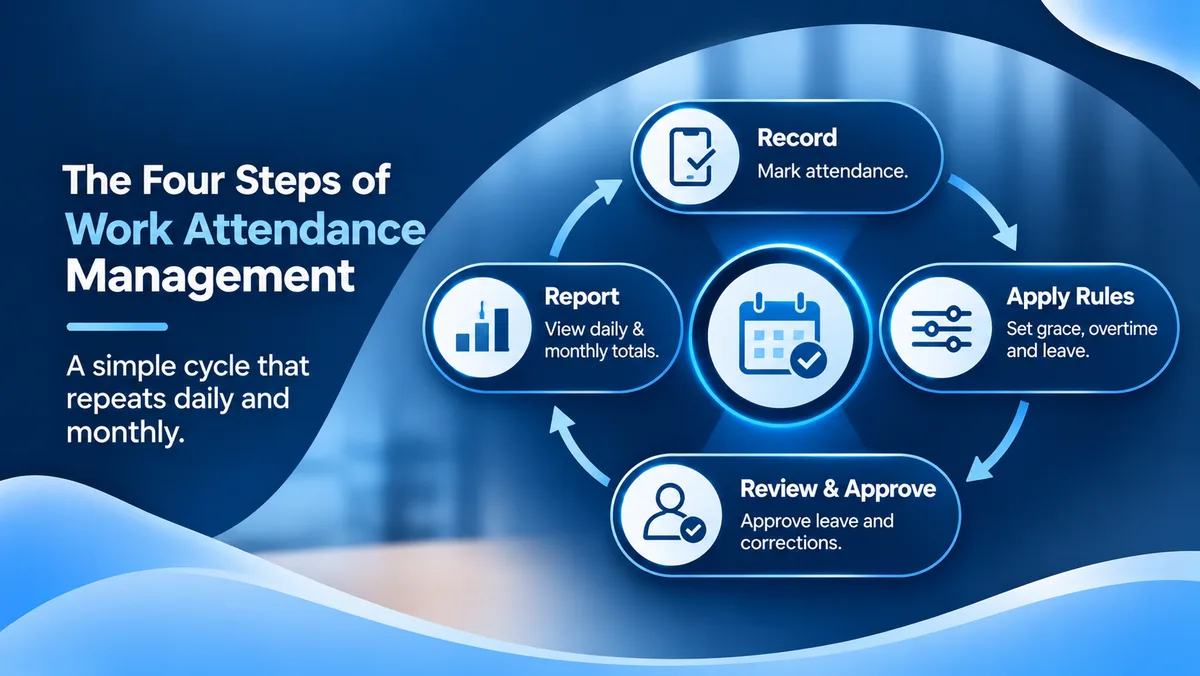
The work follows a cycle that repeats every day and every month.
Record. Employees mark attendance on a phone, a computer or a device, and the time is saved.
Apply rules. Grace time, half days, overtime, week offs and leave types turn raw times into statuses.
Review and approve. Managers approve leave and corrections, and unusual patterns are flagged.
Report. Daily views and monthly totals show what happened and feed payroll.
A weak step breaks the chain. If the rules are unclear, the record cannot be interpreted. If approvals are slow, the report is late. If the record is wrong, everything after it is wrong too.
Attendance Policy: Decisions to Write Down
Software can only apply rules that exist. Before you set up any tool, decide the points in the table below and write each one in plain words. The examples are only illustrations. Your own policy and the law that applies to you decide the real answers.
Policy point | Question to answer | Example decision |
|---|---|---|
Working hours | When does the day start and end for each team? | 9:30 AM to 6:30 PM for office staff |
Grace time | How many minutes after start is still on time? | 10 minutes |
Late marks | What happens after the grace time? | A set number of late marks counts as a half day |
Half day | How many hours count as half a day? | Less than a set number of hours in the day |
Overtime | When does it start, who approves it, how is it paid? | After shift end, with manager approval |
Leave types | Which types exist and how many days each? | Casual, sick and earned leave |
Weekly offs and holidays | Which days are paid or unpaid? | Sunday off, listed holidays paid |
Corrections | Who can fix a missed check-in, and by when? | Request with a reason, approved within a week |
When these answers are written, a manager no longer has to decide each case from scratch, and employees know what to expect.
Ways to Track Employee Attendance
Businesses use several methods, and many combine two:
Paper register. Cheap and familiar, but slow to total and easy to alter.
Spreadsheet. Easier to count, but anyone with access can change it.
Biometric device. Fingerprint or face scan at a fixed site, which needs a device at every location.
Mobile app check-in. The employee marks attendance on a phone, which suits shifts, branches and field work.
App check-in with location. The phone records where attendance was marked, which helps confirm site visits when your policy allows it.
Whatever you choose, all records should end up in one system, so reports stay accurate.
Employee Tracking: Where to Draw the Line
The phrase "employee tracking" can feel heavy. The aim of work attendance management is a fair record of the working day, not constant watching. A balanced approach looks like this:
Record what you need. Check-in, check-out and, if the work requires it, location at those two moments.
Explain it in writing. Tell staff what is recorded, why and who can see it.
Offer another way for anyone who cannot use a smartphone or location.
Limit who can view records, and keep them only as long as needed.
Trust grows when employees can see their own records. Hidden tracking has the opposite effect.
Key Features of a Good Attendance Tool
A long feature list can hide the few things you actually need. Start with this shortlist:
Mobile app that is quick and works on a slow connection.
Flexible rules for grace time, half days, overtime, week offs and shifts.
Leave management with online requests, approvals and visible balances.
Correction requests with approval and a visible history.
Live view of who is present, late or on leave.
Role-based access so managers see only their own team.
Reports you can export for payroll and reviews.
Audit trail that shows who changed a record and when.
To see how attendance, leave and employee records come together in one tool, you can look at the Attendi features page.
Remote, Shift and Field Teams
Work attendance management has to cope with teams that do not sit in one room:
Shift teams need rules tied to each person's shift, so a night-shift employee is not marked late against a day timing.
Remote staff need a simple check-in method and clear working hours, since nobody sees them arrive.
Field staff need check-in from the site, a way to handle weak network and a fair rule for travel time.
Several branches need one view for the owner, with each manager seeing only their own team.
A mobile-first system with flexible rules covers most of these cases without separate processes.
Guards, Housekeeping and Site Staff
Attendance management is not only for office employees. Guards, housekeeping staff, drivers and maintenance workers also need a clear record, and they are often left on a paper book at the gate. Housing societies show this well: guards, housekeepers and technicians depend on a committee that may be handling attendance, visitors and complaints through registers and chat groups. Platforms such as Socnivo show how a society can keep staff, visitor and complaint records in one app instead of several books. The principle applies to any workplace: every person who works for you deserves a dated, checkable record.
Record-Keeping and Legal Points
In India, many workplaces are expected to maintain attendance and wage records, and the exact requirements depend on the type of establishment, its size and the state. Rules on working hours, overtime and leave may also apply. This is general information and not legal advice. Confirm your own duties, including how long records must be kept, with a qualified labour-law or payroll professional.
Privacy and Data Safety
Attendance data is personal data: names, working patterns and sometimes location or photos. Before you choose a tool, ask:
Who can see which data, and can I limit access by role?
Is data encrypted, and where is it stored?
How often are backups taken, and how can I restore them?
Is there a log of who viewed or changed records?
Is there a clear privacy policy I can read before signing up?
A published policy is a good sign that a vendor takes the subject seriously. You can read how Attendi explains this on the Attendi privacy policy page. In India, the Digital Personal Data Protection Act, 2023 sets duties for organisations that handle personal data, and its rules are being brought into effect in stages. Confirm your own duties with a qualified professional.
How to Start in 30 Days
Most failed rollouts try to change everything in a week. A steadier plan works better.
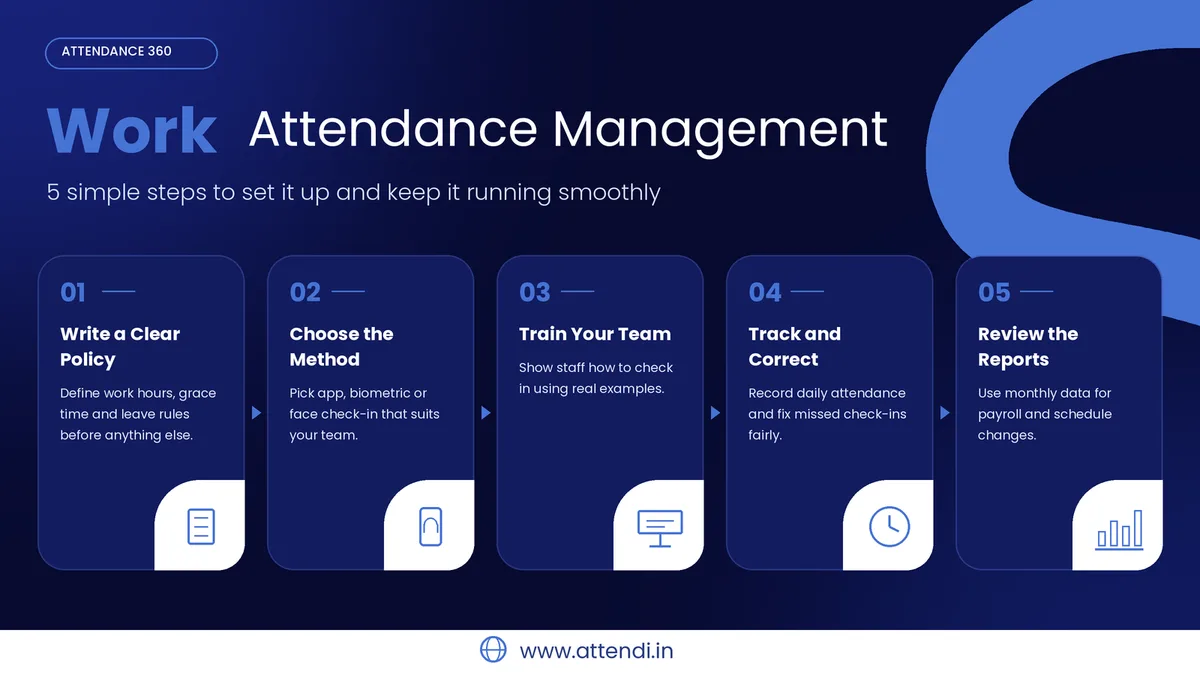
Write down your attendance policy using the decisions in the table above.
Clean your employee list with names, teams and shift timings.
Pick one pilot team with a willing manager.
Train managers first, then employees, using real examples.
Run both methods for one cycle. Keep the old register beside the new system for a month and compare the totals.
Fix differences in rules or data before switching fully.
Set a switch date. After that date, only the system record counts.
To see what the setup flow looks like before you begin, the Attendi how it works page explains it step by step.
Common Mistakes to Avoid
Starting without a written policy. If the rules are unclear, the software only records the confusion.
Tracking more than you need. Constant monitoring damages trust and adds privacy risk.
Skipping training. A short session with real examples prevents weeks of confusion.
Ignoring corrections. Missed check-ins are normal, and staff need a fair way to fix them.
Giving everyone full access. Attendance data should be visible only to the people who need it.
Never reviewing. A setup that suits ten people may need changes at fifty.
How to Measure Whether It Is Working
You do not need complex analytics. After two or three months, look at a few simple signs:
Time taken to prepare attendance totals for payroll.
Number of disputes about late marks, leave or hours.
Number of missed check-ins and corrections.
Share of leave and correction requests approved within a day.
Employee feedback on how fair and clear the record feels.
If these numbers improve, your work attendance management is doing its job.
Frequently Asked Questions
What is work attendance management? It is the process of recording when employees work, applying rules for late marks, half days, overtime and leave, and turning the records into reports for managers and payroll.
How is it different from a simple attendance register? A register only records presence. Work attendance management adds rules, approvals, corrections and reports, so the record can be trusted and used.
What should an attendance policy include? Working hours, grace time, late marks, half days, overtime, leave types, weekly offs and holidays, and how corrections are handled.
Is employee tracking legal and fair? Rules depend on your establishment and state, so confirm them with a qualified professional. For fairness, record only what you need, explain it in writing and limit who can see it.
Can small businesses use an attendance system? Yes. Small teams with no HR staff often gain the most, because the owner saves time and avoids disputes.
Does it work for remote and field employees? Yes. Mobile check-in and online leave requests work wherever employees are, as long as they have a phone and internet.
How long does setup take? For a small team, basic setup takes a few days to two weeks. Running both methods for one cycle takes most of the time.
Final Thoughts
Work attendance management is a simple cycle: record, apply fair rules, review and report. You do not need the biggest tool, and you do not need to watch your people constantly. You need clear written rules, a record that employees can see and a system your managers will actually use. Start by writing your policy, test with one real team through a full cycle and keep what works. With a careful start, attendance stops being a monthly scramble and becomes a record that everyone can trust.