Importance of Employee Relation Management Benefits and Key Practices
The importance of employee relation management is easy to miss when work is going well and very hard to ignore when it is not. A missed promotion, an unanswered complaint or a manager who never listens can turn a good employee into a silent quitter within weeks. Employee relation management is the habit of building fair, open and respectful relationships between a business and its people. In this guide, you will see why it matters, what it includes, and how companies of every size, from offices to housing societies, can put it into practice with the help of accurate attendance, leave and pay records.
What Is Employee Relation Management?
Employee relation management means handling the everyday relationship between the employer and employees in a planned way. It covers how people are heard, how problems are solved, how rules are applied and how fairly everyone is treated.
It is wider than HR paperwork. Hiring, payroll and records are part of HR, but employee relations is about trust. It answers simple questions. Can an employee raise a problem without fear? Will someone act on it? Do rules apply the same way to everyone? Does the company communicate clearly, or do people learn about changes through rumours?
Good employee relation management has three parts:
Communication: clear, regular, two-way conversations.
Fairness: the same rules and the same respect for everyone.
Resolution: a simple way to raise and settle complaints and conflicts.
Why the Importance of Employee Relation Management Is Growing
People have more choices today. They can compare employers online, talk to former colleagues and change jobs faster than before. A company that treats people badly gets noticed, and one that treats them well gets referrals. That is why the importance of employee relation management is no longer limited to large corporations. A shop with ten employees or a factory with a hundred workers faces the same human questions.
Remote work, shift work and multiple sites add to the challenge. When a manager cannot see everyone every day, a planned approach to trust and communication becomes the only reliable way to keep a team together.
Key Benefits and Importance of Employee Relation Management
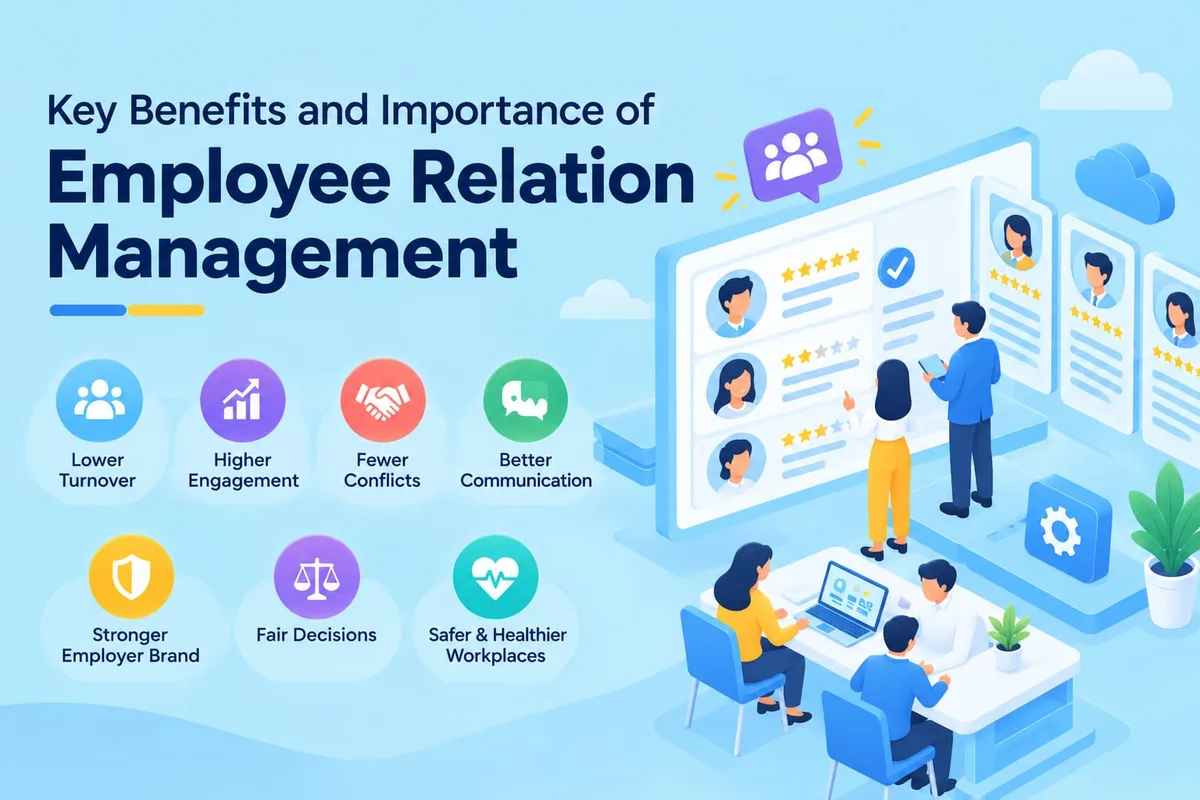
1. Lower Employee Turnover
People rarely leave a job only for pay. They leave because they feel ignored, treated unfairly or stuck. When employees know their concerns will be heard, they are more likely to stay. Lower turnover also saves the cost and time of hiring and training new people.
2. Higher Engagement and Productivity
An employee who feels respected puts in more effort. Engagement is not about free snacks. It comes from clear expectations, useful feedback and a manager who treats people as adults. Engaged teams make fewer mistakes and need less supervision.
3. Fewer Conflicts and Disputes
Small problems become big when nobody deals with them. A workplace with a clear complaint process settles most issues early, long before they reach a formal dispute. This reduces stress for managers and protects the business from avoidable legal trouble.
4. Better Communication and Fewer Rumours
When the company shares news early and honestly, rumours lose their power. Employees feel included instead of surprised. Two-way channels such as team meetings, suggestion boxes and quick surveys also bring problems to the surface before they grow.
5. A Stronger Employer Brand
Happy employees talk about their workplace in good ways. This helps you attract better candidates at lower cost. In small towns and tight job markets, reputation travels fast.
6. Fair and Consistent Decisions
When rules about leave, overtime, discipline and promotion are written and applied equally, people trust the system, even when a decision goes against them. Favouritism is one of the fastest ways to lose a team.
7. Safer and Healthier Workplaces
Employees who feel safe speaking up report hazards, harassment and burnout earlier. This protects people and the business.
Core Elements of Employee Relation Management
Open Communication
Share company updates in plain words. Hold short regular team meetings. Give managers basic training in listening. Make it easy to ask questions without fear of being judged.
Grievance Handling
Every workplace needs a simple path for complaints. A good process has a clear way to raise an issue, a named person who reviews it, a fair timeline and a written outcome. Employees should be able to see that something happened after they spoke up.
Fair Policies
Write down your rules on attendance, leave, working hours, overtime, conduct and discipline. Apply them to everyone, including senior staff. Review them when laws or conditions change.
Recognition and Feedback
Say thank you and mean it. Regular feedback, not only a yearly review, helps people improve and feel seen. Recognition does not have to cost much. A public word of appreciation or a small reward can go a long way.
Discipline With Respect
If you must take action against someone, do it privately, based on facts, and follow the written process. Respect even when the decision is hard.
Wellbeing and Support
Pay attention to workload, working hours and stress. Simple steps such as sensible deadlines, proper breaks and a supportive manager reduce burnout.
Common Employee Relations Problems and How to Fix Them
The table below shows frequent problems, what they usually cause and a practical fix.
Problem | What it usually causes | Practical fix |
|---|---|---|
Complaints go unanswered | Loss of trust, silent quitting | One clear channel, a named owner and a response deadline |
Unequal treatment | Resentment, conflict | Written rules applied to everyone and reviewed regularly |
Poor communication | Rumours and confusion | Regular updates and two-way meetings |
Attendance and leave disputes | Arguments, payroll errors | Clear policy and accurate records that everyone can see |
Salary errors or delays | Anger, loss of faith in the company | Pay calculated from verified attendance and leave data |
No recognition | Low motivation | Simple, regular appreciation and feedback |
Unsafe or stressful conditions | Absence, accidents, attrition | Safety checks, workload review and an easy way to report concerns |
The Role of Attendance, Leave and Pay Records in Employee Relations
Good intentions need good records. Many employee disputes start with a simple question: who worked when, how much leave is left, and why is this month's salary different? When attendance and leave are tracked in an accurate system, these questions are answered with facts, not memory.
This is where a tool built for workforce records helps. Attendi is designed for attendance, leave and related employee records, and you can see what it offers on the Attendi features page. When employees can check their own attendance and leave balance, and managers approve requests on clear rules, arguments at month end become rare. Salary then follows from verified data, which means fewer corrections and fewer awkward conversations.
Setting up such a system does not have to be complicated. The Attendi how it works page explains the steps from adding employees to tracking daily records, so a small business can start without a large project.
Technology also supports communication through notifications, surveys and feedback forms. But tools only help if you pair them with real action. A complaint portal that nobody reads is worse than no portal, because it teaches people that speaking up is pointless.
Employee Relations Beyond the Office: Housing Societies and Their Staff
Employee relations is not only a corporate topic. Every housing society in India depends on staff such as security guards, housekeepers, gardeners, lift operators and maintenance workers. Managing committees often handle these relationships through phone calls and WhatsApp groups, which leads to missed complaints, unclear duties and disputes about entry logs, attendance and payment.
Structured tools help here too. Platforms such as Socnivo bring visitor management, staff tracking, complaints, notices and community tools into one app for societies. A few of these ideas show clearly how good employee relations works in practice:
A helpdesk with a clear status: complaints are raised, assigned, tracked from open to resolved and rated, so no one has to chase for updates.
Notices in one place: announcements are pinned and read in a single feed instead of being lost in chat groups.
Polls and discussion: members can vote and share views, a simple model for listening to staff and residents alike.
Safety alerts: an emergency alert reaches guards and the committee together.
The lesson applies to any workplace: people trust a process they can see.
Confidentiality and Trust
Employees will only raise sensitive issues if they trust that the information stays private. Limit who can see complaints and personal records, keep notes factual and never discuss one person's case with others.
When you choose any software for attendance, leave or salary, check how it handles personal data, because these records reveal a lot about a person's life. You can read how Attendi approaches this on the Attendi privacy policy page. For legal obligations on employee data and workplace rules, speak with a qualified professional, since requirements depend on your size, industry and state.
How to Build an Employee Relations Program Step by Step
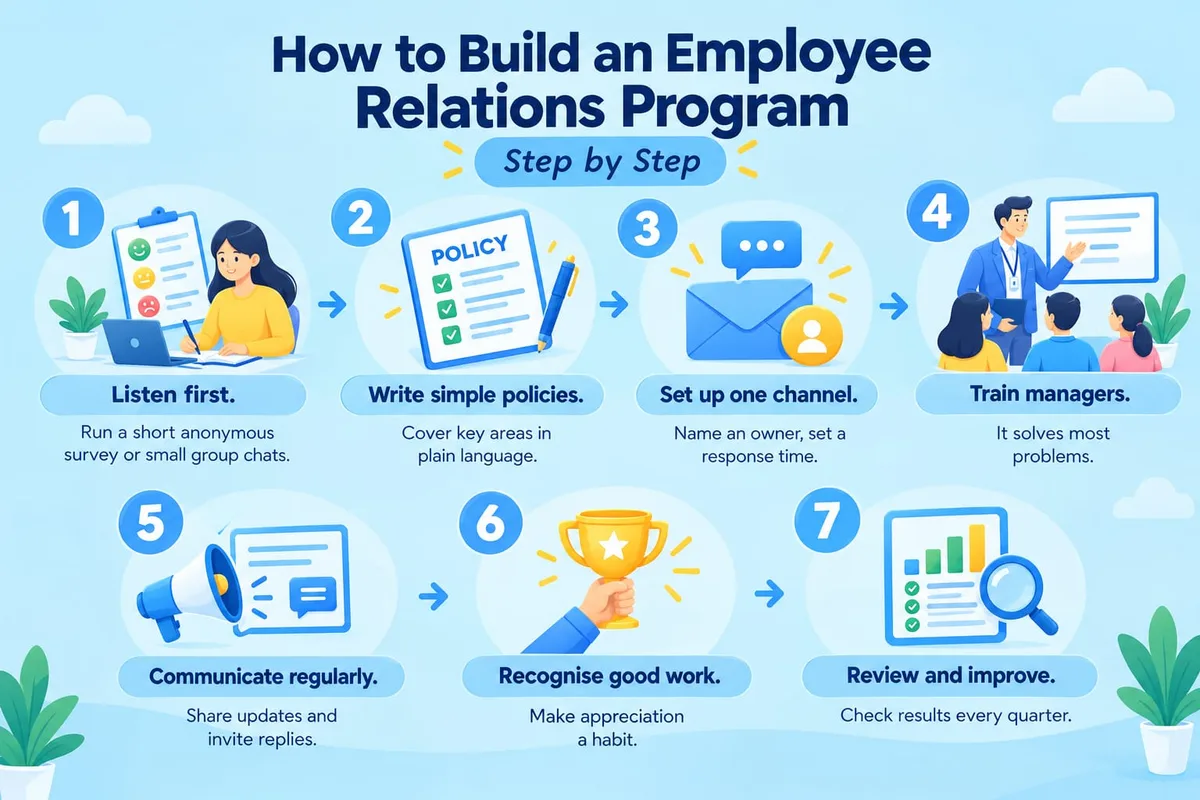
Listen first. Run a short anonymous survey or hold small group chats to learn what people really think.
Write simple policies. Cover attendance, leave, conduct, discipline and complaints in plain language.
Set up one complaint channel. Name an owner, set a response time and keep a record of each case.
Get your records right. Make sure attendance, leave and salary data are accurate and visible to the people they belong to.
Train managers. Most employee relations problems begin or end with the direct manager.
Communicate on a schedule. Share updates monthly and give people a way to reply.
Recognise good work. Make appreciation a habit, not an event.
Review and improve. Check results every quarter and adjust.
How to Measure Employee Relations
You do not need complex analytics. Track a few simple signs:
Employee turnover and the reasons people give when they leave.
Number of complaints raised and the time taken to close them.
Absenteeism and late arrivals.
Number of disputes about attendance, leave or pay, which should fall as records improve.
Results of short pulse surveys on trust and satisfaction.
Participation in meetings, polls and feedback forms.
Look at trends over time instead of a single number.
Common Mistakes to Avoid
Treating employee relations as an HR-only job. Managers shape daily experience more than HR does.
Acting only after a crisis. Small, regular steps work better than big reactions.
Collecting feedback and doing nothing. Always tell people what you heard and what you will change.
Applying rules unevenly. One exception for a favourite employee can undo months of trust.
Ignoring frontline and support staff. Guards, cleaners and helpers also deserve a voice and a fair process.
Keeping no records. Without notes and dates, even a fair decision is hard to explain.
Frequently Asked Questions
What is the importance of employee relation management? It builds trust between employer and employees, which lowers turnover, raises engagement, reduces disputes and improves the reputation of the business.
What is the difference between HR management and employee relations? HR management covers hiring, payroll, records and policies. Employee relations focuses on the quality of the relationship, such as communication, fairness and resolving problems.
Do small businesses need employee relation management? Yes. Small teams feel the effect of one unhappy employee quickly. Simple habits such as open conversations and a clear complaint process are enough to start.
How can I improve employee relations quickly? Start with listening. Ask for honest feedback, respond to the top two or three concerns and tell people what changed. Then set up a clear complaint process.
How does employee relations affect productivity? When people feel respected and heard, they spend less energy on conflict and worry, and more on their work. This usually shows up as better quality and fewer absences.
Can technology help with employee relations? Yes. Tools can make attendance, leave, notices, complaints and feedback easier to manage and track. They work best when a person is responsible for acting on what comes in.
Final Thoughts
The importance of employee relation management comes down to one idea: people do better work, and stay longer, when they trust the place they work in. You do not need a big budget to build that trust. Listen, communicate clearly, keep accurate records, apply rules fairly and solve problems quickly and privately.
Start with one change this month, such as a clear complaint channel or a short feedback survey, and build from there. Whether you run an office, a factory or the staff of a housing society, a fair and open relationship with your people is one of the best investments you can make.