How to Count and Track Employee Working Hours in India 2026 Guide
Employee working hours look simple until payday. One person says they worked nine hours, the register says eight, and the overtime question starts. Clear counting rules and clean records stop most of these fights before they begin. This guide shows how to count, track and record employee working hours the right way in India, what the law says in 2026, and which method fits your team.
What Counts as Employee Working Hours?
Working hours are the time an employee spends doing work for the employer, or waiting to be given work. That is different from the time spent inside the building.
Usually counted are time spent on assigned tasks, short paid breaks if your policy treats them as paid, waiting time when the employee must stay at the work spot, and required travel between work sites during the day.
Usually not counted are unpaid meal breaks when the employee is free to leave their post, the commute from home to the workplace, and time spent inside the premises before or after the shift for personal reasons.
Write these rules into your attendance policy. Most arguments about hours come from rules that were never put on paper.
How to Calculate Employee Working Hours
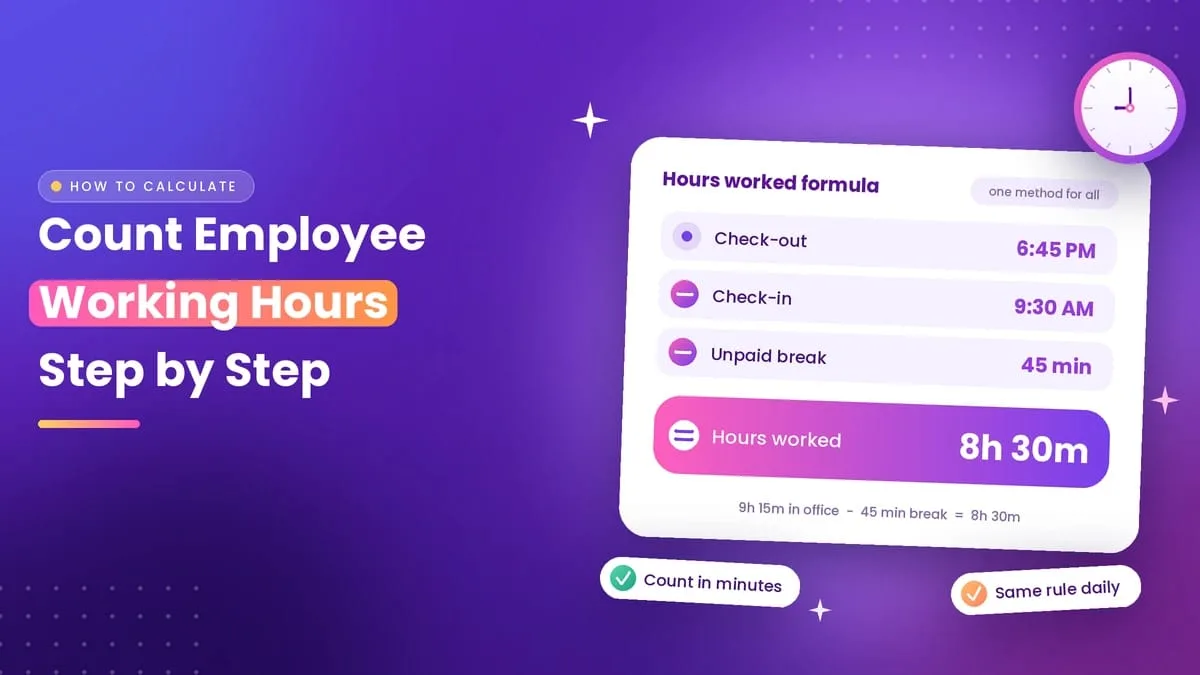
Use one method for everyone, every day:
Hours worked = Check-out time − Check-in time − Unpaid breaks
Example: A person checks in at 9:30 am and checks out at 6:45 pm, with a 45-minute unpaid lunch.
Time in the office: 9 hours 15 minutes. Minus lunch: 45 minutes. Hours worked: 8 hours 30 minutes.
Then add up the days for the week and compare the total with 48 hours.
A simple overtime example. Suppose an employee’s hourly rate is ₹150 and they agree to work 6 extra hours in a week. Overtime pay at twice the rate is 6 × ₹300 = ₹1,800. Your actual hourly rate depends on how the wage is defined and paid, so confirm the method with your payroll adviser.
Tips that save trouble later: Count time in minutes, not rounded hours. Do not round every entry down. Pick one rounding rule and use it for all staff. Record night shifts that cross midnight under the day the shift started. Treat remote or field workers the same way, with a clear start and end time.
Working Hours Rules in India You Need to Follow
Indian rules changed recently, so older blog posts can be out of date. The four Labour Codes came into force on 21 November 2025, and central rules followed in May 2026. The OSH Code sets 8 hours a day in section 25, and the 48-hour week comes from the rules.
Main Working Hours Rules
Rule | What it says | Note |
|---|---|---|
Daily hours | 8 hours a day under section 25 of the OSH Code | Many state Shops and Establishments Acts still allow offices a 9-hour day |
Weekly hours | 48 hours a week | Workers cannot opt out of the weekly limit |
Rest break | At least 30 minutes after five hours of work | Check your state rules for longer breaks |
Overtime pay | Twice the worker’s rate of wages | Applies to hours beyond the limit |
Overtime consent | Worker can be asked only with their consent | Keep the consent on record |
Overtime cap | 144 hours in a quarter under the central rules | Some guides quote 125, so confirm for your case |
Two points need care. First, guides disagree on small details, such as the quarterly overtime cap and whether the daily limit is 8 or 9 hours for some workplaces. Second, a monthly-paid worker earns overtime beyond 48 hours in a week, while a daily-wage worker earns it beyond 8 hours in a day. Your state’s own rules also matter, so check them with your labour consultant or the state labour office. This article is general information, not legal advice.
If you want to read more on payroll and overtime rules, the payroll and working hours guides on employee work-hour tracking methods cover them in simple language.
What a Staff Attendance Register Should Record
A staff attendance register is the daily record of who came, when they came and when they left. It is also your main proof if a worker, an auditor or an inspector asks questions later.
A useful register has these columns: Employee name and ID, date, check-in and check-out time, break time, total hours worked, overtime hours and who approved them, leave or holiday marks, and remarks, such as a late entry with a reason.
Common problems with paper registers: Entries made late, from memory; someone signing for a friend; missing pages or overwritten numbers; and hours added by hand at month end, with errors.
If you still use a paper register, ask the supervisor to check and sign it every day, not once a month. Businesses can also improve employee work-hour record management by keeping attendance information organised.
Using an Employee Attendance Sheet
Many small businesses move to an employee attendance sheet in Excel or Google Sheets. It is cheap, easy to learn and good enough for a team of ten or fewer.
A basic monthly sheet has one row per employee and one column per date, with a mark for present, absent, half day, leave or holiday. A second sheet holds the daily check-in and check-out times and a formula for hours worked.
Where sheets fall short: Anyone with access can change a cell, and nothing shows who did it. A broken formula can affect the whole month before anyone notices. Late or leave rules have to be added by hand. Overtime and payroll numbers need a second step.
If your sheet has grown to more than 20 people or more than one location, the time spent fixing it is usually worth more than the cost of a tool.
Common Mistakes with Working Hours
Counting only login time. The hours should match actual work, not just presence.
No written overtime approval. Because overtime needs the worker’s consent, keep a note or message that shows it.
Forgetting breaks. Unpaid breaks left in the total make hours look higher than they are.
Mixing up shift rules. Different shifts need their own start time, end time and break.
Keeping records in different places. Attendance in one file, leave in another and payroll in a third leads to mismatches.
Ignoring state rules. The central rule sets the base, but your state may add more.
Paper, Sheet or Software: Which One Fits?

Paper register: a very small team in one place, with daily supervisor checks.
Excel or Google Sheet: up to about 20 people, one location, and one person who owns the file.
Attendance software: several sites, field staff, overtime, and leave and payroll that need to match.
Software helps when attendance, leave and working hours need to agree without retyping. In Attendi, for example, you can set working hours and late rules, and view attendance reports in the same place as leave. If you want to see how the check-in flow works before choosing, the how it works page shows the steps. Businesses exploring automated work-hour monitoring solutions can also assess options for organising employee time records.
Whatever you pick, the same basics apply: one clear rule for counting hours, one record that cannot be quietly changed, and a monthly check of the numbers against payroll.
Employee Working Hours FAQs
What are the legal employee working hours in India?
The OSH Code sets 8 hours a day and 48 hours a week. Some state laws allow a 9-hour day for offices, but the 48-hour weekly limit stays. Check your state’s rules.
Is the lunch break part of working hours?
It depends on your policy. If the employee is free to leave their post, it is usually unpaid and not counted. Write the rule in your policy.
Can an employer force overtime?
No. Overtime needs the worker’s consent, and it must be paid at twice the ordinary rate.
What is the difference between a staff attendance register and an attendance sheet?
A register is the daily record, often on paper, with times and signatures. A sheet is a digital version, usually monthly, that also sums hours and leave. Many firms use both: the register as the source and the sheet for payroll.
How do I check if my hours records are correct?
Compare weekly totals with the 48-hour limit, check overtime approvals, and match the monthly total with payroll before paying salaries.
Final Thoughts
Good records protect both sides. Employees get paid for the time they worked, and employers have proof if someone asks. Start with a clear policy on what counts as work time, pick one way to track it, and review the numbers every week instead of waiting for month end. If your paper register or sheet has started to cause mistakes, try a tool with your own team. You can test Attendi with a 3-day free trial and compare the results with your current records.
Businesses looking for custom working-hours tracking system integration can explore whether a customised solution fits their requirements.