Employee Working Hours in India Rules Schedules and Extra Hours
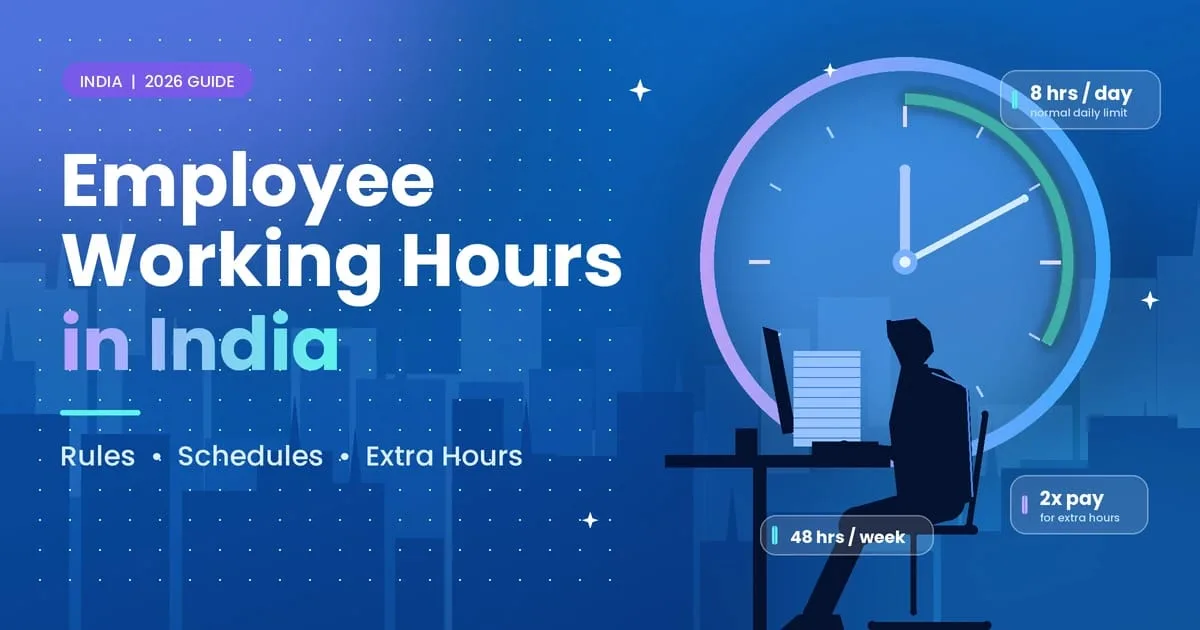
Employee working hours look simple on paper: come in, work eight hours, go home. In practice, owners struggle with questions that decide pay and trust. When does the clock start? Do breaks count? Who approves extra hours, and what is the rate? A clear policy, written down and backed by a record, answers all of these before they turn into arguments.
This guide explains what counts as employee working hours, what the rules for working hours in India say, how to build a fair work schedule, how to treat extra hours, and how to track all of it without drowning in paperwork.
What Counts as Employee Working Hours?
Employee working hours are the time a person is required to be on duty and available for work. That includes the time spent on tasks, short waits between tasks, and paid breaks if your policy says they are paid. It usually does not include an unpaid lunch break, or the time a person spends travelling from home to the workplace.
A simple way to calculate a day is out time minus in time minus unpaid break. If a person arrives at 9:00, leaves at 18:00 and takes a one-hour unpaid lunch, the day is eight hours. Write this rule into your policy, because most disputes about employee working hours begin with two people counting the same day in different ways.
Working Hours in India: What the Law Says
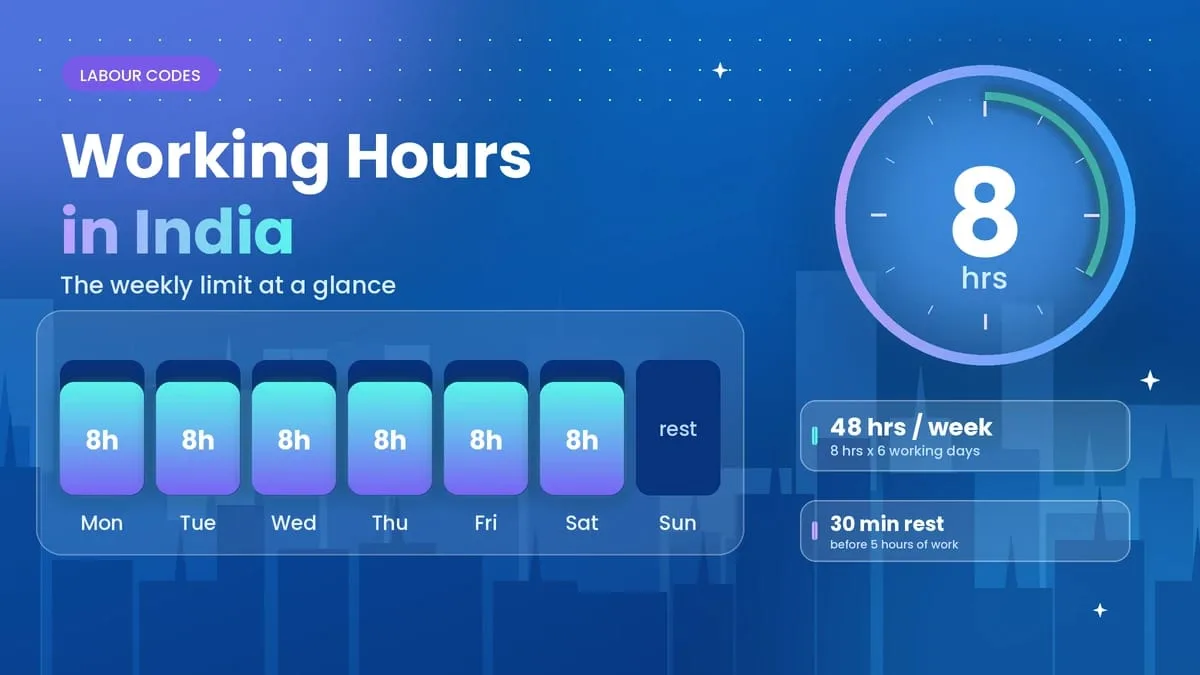
Working hours in India are set by labour laws, and they are changing. The four labour codes came into force on 21 November 2025. Under the Occupational Safety, Health and Working Conditions Code, a worker should not be required to work more than 8 hours a day and 48 hours a week. Draft central rules allow the period of work, including rest breaks, to be spread over up to 12 hours in a day, and they say a worker should have a rest interval of at least half an hour before completing five hours of work.
State laws still matter. Many state shops and establishments acts, which cover offices, shops and commercial places, have long set a normal day at 9 hours and a week at 48 hours, with an interval for rest after five hours and a spread-over of 10.5 or 12 hours. Limits on extra hours differ by state, for example a weekly or yearly cap. Because of this, check which rule applies to your establishment and state, and ask a labour law adviser if you are unsure. This is general information, not legal advice.
Office Hours in India: What Is Typical
Office hours vary by company and city, but a common pattern is a start between 9:00 and 10:00 in the morning and a finish between 18:00 and 19:00 in the evening, with a lunch break of 30 to 60 minutes. A 9-to-6 day with a one-hour lunch gives eight working hours, which matches the daily limit in the codes. Some offices follow a 9:30 to 18:30 pattern, and many private companies run five-day weeks of about 40 hours.
Shops, restaurants and factories do not follow office hours. A shop may open at 10:00 and close at 21:00, covered by split shifts. A factory may run three shifts of eight hours. The point is the same everywhere: the posted hours are the start, and the record of actual hours is what counts.
Work Schedule Types and When to Use Them
A work schedule is the plan that says who works when. Pick the type that fits how your business gets its work done.
Schedule type | How it works | Best for | Watch out |
|---|---|---|---|
Fixed schedule | Same start and end time every working day | Offices, schools, back-office teams | Little room for personal needs or peak demand |
Shift schedule | Set shifts such as morning, evening and night | Factories, hospitals, security, retail | Fair rotation and enough rest between shifts |
Rotating schedule | Teams move across shifts on a cycle | Round-the-clock operations | Tiredness and clashes with family time |
Flexible schedule | Core hours fixed, start and end time open | Knowledge work, hybrid teams | Needs clear rules and tracking, or hours drift |
Compressed week | Longer days in fewer days a week | Teams that want longer weekends | Total weekly hours and rest rules still apply |
Split shift | Work in two parts of the day with a gap | Restaurants, shops, schools | Long total spread of the day |
Security guards and housekeeping staff in housing societies are a good example of a shift schedule, because the gate and the building need cover at all times, and each person’s hours must still stay within the limits.
Extra Hours: Overtime Rules and Pay
Extra hours are the hours worked beyond the normal limit. Under the labour codes, extra hours are paid at twice the ordinary rate of wages, and the worker should agree to do them. Under the rules, a fraction of an hour between 15 and 30 minutes is counted as 30 minutes, and a fraction of more than 30 minutes is counted as a full hour. State laws and the central rules can also cap the extra hours in a quarter or a year, so check the cap that applies to you.
Here is a simple example. A worker is paid ₹800 for an 8-hour day, so the hourly rate is ₹100. If the worker puts in 2 extra hours, overtime at twice the rate is ₹100 × 2 × 2 hours, which is ₹400. The day’s pay becomes ₹1,200. What counts as the ordinary rate of wages can include allowances as well as basic pay, so ask your accountant how it applies in your case.
Treat extra hours as an exception that a manager approves, not as a habit. If the same person works overtime every week, the schedule probably needs another worker or a change in how the work is planned.
How to Plan a Fair Work Schedule
A fair work schedule starts with demand. Look at when work is busiest and quietest, then place people where they are needed. Give each person a regular day off, leave enough rest between two shifts so that nobody works late and starts early the next day, and rotate the unpopular shifts evenly.
Publish the schedule well before it starts, and set a notice period for changes. When a swap or a change is needed, share the schedule and any change with staff in time, so that nobody learns about a shift change at the gate. Keep a record of approved swaps, because the hours worked must still be recorded under the person who actually did them.
How to Track Employee Working Hours
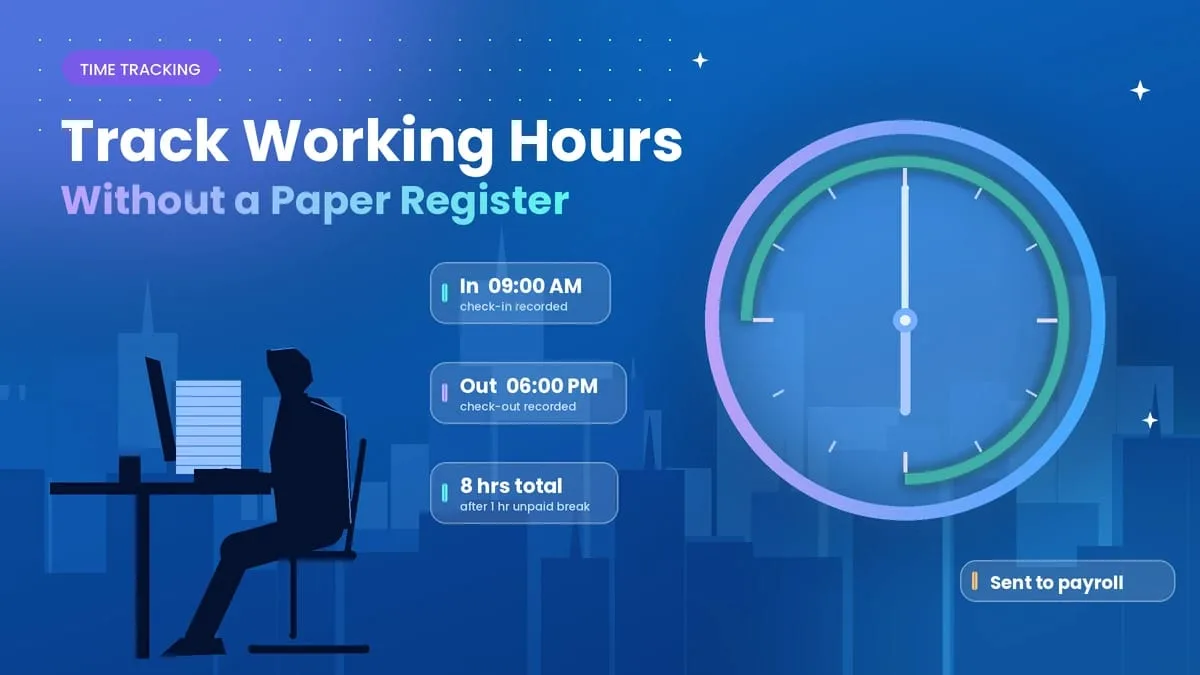
Tracking turns the schedule into a record. The oldest method is a paper register, which is cheap but easy to alter and slow to total. Spreadsheets help with totals, but someone has to type every entry. Biometric machines and phone apps record the time as the person arrives and leaves, and the software adds up the hours by your rules.
A good system does four jobs. It records in and out times, subtracts unpaid breaks, flags hours that cross the daily or weekly limit, and sends the totals to payroll. You can see how hours move from check-in to payroll on a real product page. Reports that group late arrivals, early exits and extra hours by person and date make the weekly check quick, and they are listed as working hours and reports features in Attendi.
Some businesses want a tracker built around their own rules, for example with special break rules or a link to an in-house system. That is possible with a tracker built by an IT team around their own rules, but it takes time and money to build, test and maintain, so most teams start with a ready-made app.
What Tracking Costs
Apps charge per employee per month. Attendi’s per-user plans run from ₹39 to ₹59 plus 18% GST. For 25 employees on the ₹59 plan, that is ₹1,740.50 a month with GST. Compare that with the hours your supervisor and accounts team spend each month fixing registers.
Common Mistakes With Working Hours
The most common mistake is recording only the shift time and not the actual time, which hides late exits and extra hours. The second is ignoring breaks, so a nine-hour presence is counted as nine hours of work. The third is informal extra hours, where a manager asks someone to stay late and nobody records it, which leads to unpaid overtime and later disputes.
Other mistakes include no weekly day off, no written consent for overtime, schedules changed at the last minute without a record, and copying a rule from another state without checking the local one. A short written policy, a daily record and a monthly review prevent most of these.
Records You Should Keep
Labour rules expect employers to keep an attendance-cum-muster roll and an overtime register, and they can be kept on paper or electronically. Whatever you choose, the record should show the date, the in and out times, the breaks, the hours worked and the extra hours for each person. If you are new to this, these guides on how to keep daily attendance records are a useful starting point. Ask your accountant or legal adviser how long you must keep the records, and keep them safe, because they hold names and wage details.
A Look at Attendi
Attendi is an attendance and payroll app for office, multi-location and field teams, available on Android and iOS. Plans are priced per user per month, with 18% GST extra. The Basic plan costs ₹39 and includes QR attendance, leave, working hours and reports. The Advanced plan costs ₹49 and adds selfie attendance and payroll. The Pro plan costs ₹59 and adds face capture and field workforce tracking. There is a 3-day free trial in the app, so you can test how employee working hours are recorded with your own team.
FAQs
What are employee working hours? They are the hours a person is required to be on duty and available for work, usually counted as out time minus in time minus unpaid breaks.
What are the standard working hours in India? The labour codes set normal work at 8 hours a day and 48 hours a week. Many state shops and establishments acts use 9 hours a day and 48 hours a week, so check your state.
What are typical office hours in India? A common pattern is about 9:00 to 18:00 with a 30 to 60 minute lunch break, which gives about eight working hours.
How are extra hours paid? At twice the ordinary rate of wages, with the worker’s consent. A fraction of 15 to 30 minutes is counted as 30 minutes, and more than 30 minutes is counted as a full hour.
How long can a person work without a break? The rules expect a rest interval of at least half an hour before a worker completes five hours of work.
What is a work schedule? It is the plan that says who works when, such as a fixed day, a set of shifts, a rotating cycle or a flexible pattern with core hours.
Can I track working hours on a phone? Yes. Apps record check-in and check-out with time and often location, and the software totals the hours for payroll.
Final Thoughts
Good employee working hours management comes down to four habits: a written policy, a fair work schedule, a record of actual hours and a clear rule for extra hours. Check the working hours in India that apply to your state, keep the office hours and shifts realistic, and use a tracker so the numbers on payday are the numbers people worked.